View our privacy statement for more information and how to manage them.
The following provide answers to the frequently asked questions about wastewater treatment systems for single houses in general and questions on the EPA’s guidance document – Code of Practice: Wastewater Treatment and Disposal Systems Serving Single Houses (p.e. <10).
If your query is not answered below and if it relates to a site-specific question then you should contact your local authority in the first instance. Local authorities can contact the EPA for advice and assistance if they have specific technical questions about the wastewater treatment code of practice. If your question is about planning permission then you should contact your local authority, as this is an area that is not dealt with by the EPA.
The EPA wish to acknowledge the input and work from Ms. Martina Smith and the Clean Water Team at Monaghan County Council in preparing these questions.
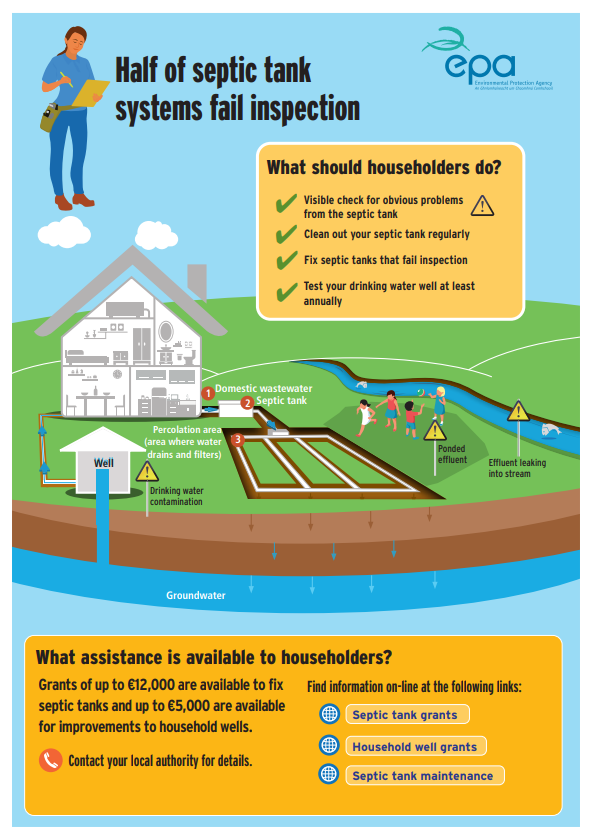
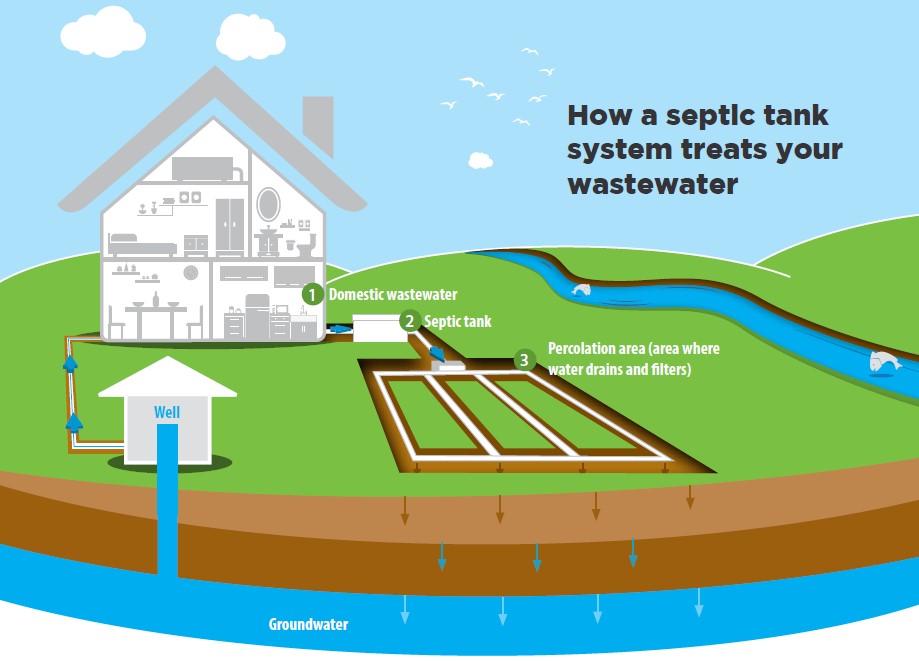
A modern septic tank system includes a double chamber tank and percolation area. Wastewater is partially digested by bacteria in the septic tank and the effluent then passes through a percolation area where effluent is further treated.
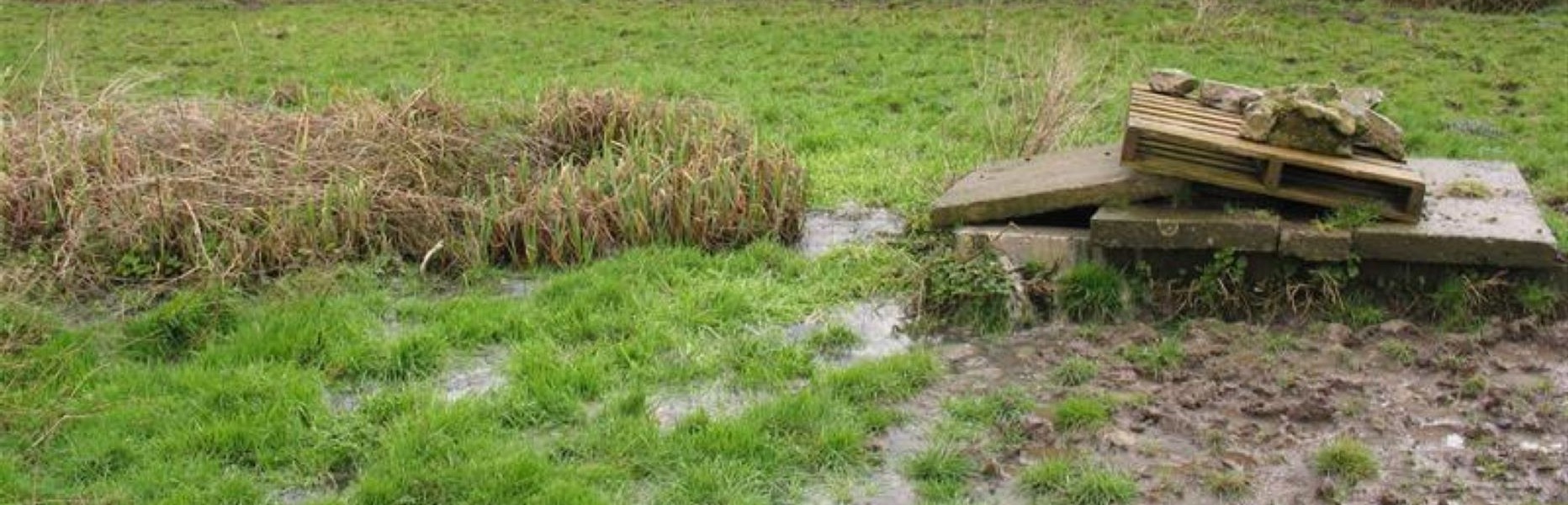
Some signs that your wastewater treatment system may not be working include the following:
First of all you should arrange to have your system de-sludged. If it is an advanced wastewater treatment system you should contact the supplier/installer of your system and have your system serviced.
Yes it is possible. If you suspect that your wastewater treatment system is affecting your well you should have it checked. If you are concerned you should contact your local authority’s Environmental Section or local Environmental Health Officer for advice.
If you suspect contamination of your well you need to have a full assessment of your wastewater treatment system carried out by a suitably qualified person.
Before buying a house you should have the septic tank or wastewater treatment system inspected by a suitability qualified person. You should ask for installation and maintenance records for the system. You should check that the treatment system will adequately serve the anticipated number of occupants of the house.
If the house is served by a DWWTS, the seller of the house should provide you with a copy of the certificate of registration for the domestic waste water treatment system as provided for in Section 70 D of the Water Services (Amendment) Act 2012.
The new homeowner is obliged to inform the local authority of the change of ownership and such that the register can be updated.
Under no circumstances should you build over a septic tank or percolation area. Access to the tank is needed for regular maintenance and the percolation area should not be compacted.
Even with a hard standing area located above a percolation area traffic may damage percolation pipes and result in ponding or escape of untreated effluent.
The site suitability assessment process will determine the suitability of a site but the ultimate decision will rest with the local authority or planning authority
If the level of sludge builds up in the tank it may make its way out of the tank and block the distribution box and the percolation area or polishing filter. And if the percolation area or polishing filter becomes blocked it is very difficult to clean and may require replacement – an expensive option!
The minister has published new regulations (Performance Standards S.I. No 223 of 2012) governing the operation and maintenance for domestic wastewater treatment systems (DWWTSs). These require owners of DWWTS to operate and maintain their systems and this includes de-sludging.
Don’t be tempted to turn off the power to save electricity - If there is no air going to the system it becomes an undersized septic tank and treatment is ineffective. You should also check the distribution box i.e. the manhole between the wastewater treatment system and the percolation area to ensure even distribution of effluent and ensure there are no blockages.
It is recommended to de-sludge a septic tank at least once a year but this varies with the system’s capacity and use. You must de-sludge the septic tank if scum is present in the second chamber or if the sludge comes up to about 400mm from the bottom of the tank. A minimum of 75mm of sludge should remain in the tank to assist in the re-seeding of the new sludge. Regular maintenance is required to ensure that the septic tank operates effectively and that solids do not enter the percolation area and clog the distribution pipe work.
Grease traps capture the oil and grease from the flow of wastewater by slowing down the flow of hot greasy water through the trap and allowing it to cool. As it cools, the grease and oil separate out of the water and float to the top of the trap. The cooler water then flows to the septic tank where it is treated. Grease traps are usually not included in the design of a domestic wastewater system but are mandatory in systems treating water from restaurants, hotels and any other businesses that supply food.
Due to the absence of these systems in single dwellings it is highly important that people do not allow any fats, grease or oils to enter their septic tank systems. The inlet pipes can become clogged up by the fats and grease and therefore can reduce the treatment rate of the septic tank system. To insure that this doesn’t happen to your system, all fats, grease and oils must not be disposed down the sink or drains.
The frequency of de-sludging is dependent on the size of the tank and the number of persons living in the house.
Best practice for the management of DWWTS indicates that de-sludging should be undertaken when the level of sludge on the bottom of the tank is greater than approximately 400 mm. A minimum of 75mm of sludge should remain in the tank to assist in the re-seeding of the new sludge. Regular maintenance is required to ensure that the septic tank operates effectively and that solids do not enter the percolation area and clog the distribution pipe work.
In Ireland, there are approximately 440,000 houses with domestic waste water treatment systems and on the basis of US figures the annual septage volume can be estimated at 0.372 x 10⁹ litres /year or 372,000 m3/year.
It is recommended that a waste contractor that has an appropriate waste collection permit be employed to de-sludge a septic tank or DWWTS. A list of approved permit holders is available from the Environment Section of your Local Authority.
Householders having their septic tanks de-sludged should ensure that they retain a receipt from the permitted waste undertaker who de-sludges the tank.
The receipt should include the following information:
Individual landowners can dispose of sludges from their own DWWT system by land spreading, strictly in accordance with the requirements of the Waste Management (Use of Sewage Sludge in Agriculture) Regulation, S.I. No. 148/1998, as amended.
Permitted waste collectors can also dispose of sludge’s by landspreading where their Waste Collection Permit allows them to do so strictly in accordance with the requirements of the Waste Management (Use of Sewage Sludge in Agriculture) Regulation, S.I. No. 148/1998, as amended.
The Permitted Waste collector must ensure that sludges are treated and disposed/recovered in accordance with legislative requirements.
If possible, the system should not be used until flooding subsides below the level of the tank, but this is more to prevent water backing up into a property than any other reason.
In short, many systems will be robust, they will be recovered and will be usable after a flood.
Where electrical components are used or damage is suspected - then a professional assessment (and repair) is necessary.
There is no significant environmental concern above and beyond that posed by the wider flooding event.
As always, do not enter flood waters as manholes may have been dislodged and the flood water will be contaminated and may pose a risk to health.
In the first instance, you are advised to contact the local authority. In relation to the concern that the wastewater treatment system is potentially contaminating the well, advice should be sought from the environment section and the local Environmental Health Officer (EHO).
In addition to the above, Section 70 of the Water Services Act 2007 (Water Services Act 2007) sets out the general duties on an owner of a domestic wastewater treatment system. It provides that the local authority or 'any other person affected by the failure...' may complain to the District Court if there is a failure by the owner of the domestic waste water treatment system (DWWTS) to comply with the general duties set out. See provisions below in subsection 6 and 7.
“(6) A water services authority or any person affected by a failure, or alleged failure of a third party to comply with a duty of care provided for under this section may complain to the District Court, and the Court may order the third party to take the measures necessary to effect a cessation of the activity which is the subject of the complaint, or to take specified measures to effect compliance with their obligations under this section.
(7) Before a complaint is made to the District Court under subsection (6), the water services authority or the person concerned, as the case may be, shall serve a notice in the prescribed form of the intention to make such a complaint, within such time as may be specified in the notice, on the said third party.”
The Water Services Act was amended in 2012 Water Services (Amendment) Act 2012) and provides additional requirements on the owner of domestic waste water treatment systems (DWWTSs) in terms of performance of their systems. New regulations (Performance Standards S.I. 223 of 2012) have been published in relation to the operation and maintenance of DWWTS.
In the first instance, you should contact the environment section of the local authority for advice.
However, Section 70 of the Water Services Act 2007 (Water Services Act 2007) sets out the general duties on an owner of a domestic wastewater treatment system. It provides that the local authority or ‘any other person affected by the failure…’ may complain to the District Court if there is a failure by the owner of the domestic waste water treatment system (DWWTS) to comply with the general duties set out. See provisions below in subsection 6 and 7.
The Water Services Act was amended in 2012 (Water Services (Amendment) Act 2012) and provides additional requirements on the owner of domestic waste water treatment systems (DWWTSs) in terms of the performance of their systems. New regulations (Performance Standards S.I. 223 of 2012) have been published in relation to the operation and maintenance of DWWTS.
“The owner of a premises shall ensure that all drains, manholes, gullytraps and storage and treatment systems for wastewater, including related accessories, not in charge of a water services provider, which serve that premises are kept so as not to:-
(a) cause, or be likely to cause, a risk to human health or the environment, including to waters, the atmosphere, land, soil, plants or animals, or
(b) create a nuisance through odours.”
For new builds site characterisation must be carried out in accordance with the EPA Code of Practice for Wastewater Treatment and Disposal Systems Serving Single Houses (p.e≤10), 2009. The EPA Code of Practice can be downloaded at the following location http://www.epa.ie/downloads/advice/water/wastewater/.
Section 3 of the Local Government, (Water Pollution) Act, 1977 as amended by the Local Government, (Water Pollution) Amendment, Act, 1990 prohibits the entry of polluting matters to waters.
If using a contractor to de-sludge you wastewater treatment system you must ensure that the contractor holds an appropriate Waste Collection Permit for European waste code 20 03 04. You may be breaking the law if you use an unlicensed contractor to de-sludge your system. A list of licensed contractors operating in is available from your local authority.
There are a variety of ways to obtain a copy of the Code of Practice Wastewater Treatment and Disposal Systems serving Single Houses (p.e. £10)
The Wastewater Treatment Manual for Single houses can be downloaded from www.epa.ie
It is also possible to purchase the Wastewater Treatment Manual by writing to:
Publications OfficeEnvironmental Protection Agency,PO Box 3000,Johnstown Castle Estate,Wexford
Or calling Publications Office at 053 9160642
Payments may be made by cheque, postal order or bank draft made out the Environmental Protection Agency or by credit card for web and telephone sales.
This course is no longer being run by FAS. However, you are advised to contact the Water Services Training Group for information on when this course will be run.
Water Services Training Group,
Monastery Road, Roscrea, Co. TipperaryPhone: (0505)24688 | Fax: (0505) 23427 | E-mail: wsntg@eircom.net
Detail of how to carry out site characterisation for a wastewater treatment system for single houses can be obtained in Section 6 and Annex C of the Code of Practice Wastewater Treatment and Disposal Systems serving Single Houses (p.e. £10) (2009).
A list of persons having successfully completed the FAS training course may be available from FAS at 01 6070500. Otherwise prior to employing a site suitability assessor ask to see a copy of their FAS certificate as proof of completion of the course.
A percolation test is a method of assessing the ability of the subsoil to allow water to percolate to the water table (i.e. how water can pass through the soil). In the test a small hole is excavated and the time taken for the water to drop in minutes is recorded. It is recommended that a suitably qualified person carry out percolation tests. Contact your local authority to obtain a list of qualified persons. For more information on these tests, see Annex C of the CoP.
Ϯ or as far as possible for the more slowly draining subsoils
* if the water fully percolates within 10 minutes then proceed to Step 3
If a T test fails; a P test should be carried out only where the T test result is less than 90. If the percolation test result is greater than 90 then discharge to ground is not recommended as ponding will occur.
The P-test will establish if it is possible to install a constructed percolation area or a polishing filter. It determines whether the upper layers of the subsoil are permeable enough to allow percolation of the treated wastewater into the ground.
If the P test passes it may be possible to install a secondary treatment unit with a polishing filter – see Sections 8, 9 and 10 of the CoP for more details.
If both the P and T test fail, it is only permitted to discharge the effluent to surface waters. A water pollution licence must be obtained from your local authority. See Section 6 and Annex C of the CoP for more information on P and T tests.
A planning authority is currently entitled to request any information on site suitability for an on-site wastewater disposal system from the applicant that it considers necessary to make a decision on an application for planning permission. Under Article 22 (2)(c) of the Planning and Development Regulations 2006, where it is proposed to dispose of wastewater other than to a public sewer, the applicant must submit information on the type of on-site wastewater treatment system proposed and evidence as to the suitability of the site for the system proposed as part of the planning application.
Firstly, a suitably qualified person must carry out a site assessment in accordance with the guidance set out in the Code of Practice Wastewater Treatment and Disposal Systems serving Single Houses (p.e. £10) (2009). This is then followed by the selection of a suitable wastewater treatment system, which is dependent on the site conditions determined during the site assessment.
The choices of on-site wastewater treatment and disposal systems are;
It may be required to discharge effluent to surface waters if the percolation tests fail, in which case a discharge licence from your local authority is required.
A dilution calculation is carried out to estimate the potential impact on the groundwater quality of allowing a wastewater treatment system to be installed. The only parameter that Local Authorities would need to vary is recharge, which could be reduced in the drier counties. Recharge rates may be obtained from Met Eireann. Details on carrying out dilution calculations may be found in Annex D.2 of the CoP.
The Irish Agrément Board is part of the National Standards Authority of Ireland (NSAI) and is the national certifying body. Its function is to assess, test, and where appropriate, issue Agrément Certificates in respect of materials, products, systems and technicques used in the construction industry, particularly those used of an innovative nature, in order to facilitate their ready acceptance and their safe and effective use. Agrément Certificates provide the Board's opinion of the fitness for specified purposes of materials, products, systems and techniques, taking into account the context in which they are to be used.
A water pollution discharge licence is required from the local authority
Or
[1] Groundwater Protection Schemes 1999 EPA/DEHLG/GSI can be purchased from the EPA Publications Office or from the EPA website.
Yes in some cases – a clustering of wastewater treatment systems in areas with poor soil percolation properties may pose a risk to local surface waters while a clustering of wastewater treatment systems in areas with very shallow soil and high percolation rates may pose a risk to local ground waters. The use of soakpits significantly increases the risk factor and households using soakpits should consider upgrading their systems. It is likely that the use of soakpits will be targeted in new legislation and in measures adopted to protect surface and ground waters.
The minimum recommended distances for the above are set out in Table below.
To disinfect a well you must:
1. Obtain 9 litres (2 gallons) of 3% strength or 4.5 litres (1 gallon) of 5% strength e.g. Parazone) bleach.
2. Make up to 22.5 litres (5 gallons) by adding water and mix thoroughly.
3. If sampling during a pumping test, on the day before the test starts pour half of the solution into the well.
4. Start the pump and let it run briefly until water with a distinct smell of chlorine pours from the outlet pipe.
5. Turn off the pump immediately. Add the remainder of the solution and leave overnight.
6. Pump to waste until the smell of chlorine disappears before taking a sample for analysis.
If sampling from a well that is connected to a house, pour half of the solution into the well, start the pump and open all taps until water from each tap has a distinct smell of chlorine. Stop the pump and add the rest of the solution. Allow this to stand for 12-24 hours and then pump to waste until the smell of chlorine disappears.
In addition you should try to determine what is causing the contamination. What activities are taking place within 50m radius of the well? Is there adequate protection around the top of the well?
For more information on disinfecting wells, see the GSI website.
A site suitability assessment is required to be completed prior to selecting any system. If the site is suitable for a constructed wetland then the following should be noted.
Any discharge from a constructed wetland to surface water requires a water pollution discharge licence in accordance with the Water Pollution Acts 1977-1990. Specific information can be obtained from the local authorities.
If discharging from the constructed wetland to ground, a polishing filter will be required. If the discharge is greater than 5m3/day, then a water pollution discharge licence is required as well as additional prior investigations.
It should also be noted that constructed wetlands should be inspected weekly to ensure that there is no evidence of varying flow distribution or blockage, that the sidewalls are maintained and that the reeds have not been damaged. See the Wastewater Treatment Manual for Single Houses or contact the Environment Section of your local authority for more information.
The European Court of Justice has ruled that countries must comply with certain standards and procedures, such as inspections, to ensure that public health and the environment are protected.
Poorly constructed or operated on-site wastewater treatment systems (including septic tanks) for single houses can result in sewage contaminating drinking water supplies or ponding on land, presenting a risk to human health as well as the environment.
All homeowners that have domestic wastewater treatment systems (DWWTS) are required to register their systems with the local authority where the DWWTS are located.
However, owners of properties connected to larger on-site systems where the discharge is in excess of 5 cubic metres per day do not need to register (i.e sports clubs, pubs, hotels, guesthouses and other businesses). Instead such systems may require a licence from the relevant local authority under Section 4 of the Water Pollution Act 1997.
To register please go to www.protectourwater.ie
In the situation where more than one house shares a domestic waste water treatment system, each individual household must register.
Owners of domestic waste water treatment systems are required to register their systems with their water services authority. They can register online, by post or at your local authority office.
Online - www.protectourwater.ie - by credit card/debit card.
By Post:Registration forms are available online; from City/County Councils; Libraries; Citizen Information Centres or Lo Call 1890 800 800.
Payment can be made by cheque, postal order or bank draft and made payable to “Protect Our Water". Send your form with payment to: Protect Our Water, P.O Box 12204, Dublin 7.
Local Authority Offices:Payment by credit or debit card or by cheque, postal order, bank draft or cash can be made in your City or County Council office (no administration fee will be charged by the Council for this).
A once off registration fee of €50.00 is payable to cover the costs of administration by the WSA and of the risk based inspection.
The legislation requires the EPA to develop a ‘National Inspection Plan’. A risk based approach is beiing used to select sites for inspection. What that means is that the areas at most risk of contamination of groundwater, surface water or human health are more likely to be inspected first. The risk maps are available to view at http://gis.epa.ie/myenvironment#/search.
All existing DWWTS should have registered by the 1st February 2013, if you have not registered already you may still do so, see www.protectourwater.ie for more information.
All new developments where a DWWTS is constructed or installed shall ensure that the system is registered with the WSA within 90 days of connection of the premises to the DWWTS (S.I. 180 of 2013).
An appropriately qualified and EPA registered inspector. A list of authorised inspectors will be made available in due course. The local authority will inform you in advance if you have been selected for inspection. Inspections are due to commence in July 2013.
No access to the house itself will be required. The local authority will advise you of the inspection in advance.
The Minister for the Environment, Community and Local Government has announced a grant scheme for those who fail an inspection. More details may be obtained for the DECLG's website - grant information.
The Minister has made regulations regarding the appointment of inspectors (S.I. No. 384 of 2012). The regulations state tha the EPA shall appoint a person to inspect DWWTS if:
The Minister has published new regulations (Performance Standards S.I. No 223 of 2012) governing the operation and maintenance for domestic wastewater treatment systems.
The standards in the Code of Practice: Wastewater Treatment and Disposal Systems Serving Single Houses 2009 (CoP) apply to all new developments. They do not strictly apply to existing houses, however, where problems arise improvements may be necessary in line with best practice as outlined in the code. The local authority may allow variations to the CoP when it is satisfied that the proposed improvements will reduce the impact on human health and the environment.
The Code of Practice is available to download at http://www.epa.ie/downloads/advice/water/wastewater/code%20of%20practice%20for%20single%20houses/#d.en.27967.
However, owners of properties connected to larger on-site systems where the discharge is in excess of 5 cubic metres per day do not need to register (i.e sports clubs, pubs, hotels, guesthouses and other businesses). Instead such systems require a licence from the relevant local authority under Section 4 of the Water Pollution Act 1997.